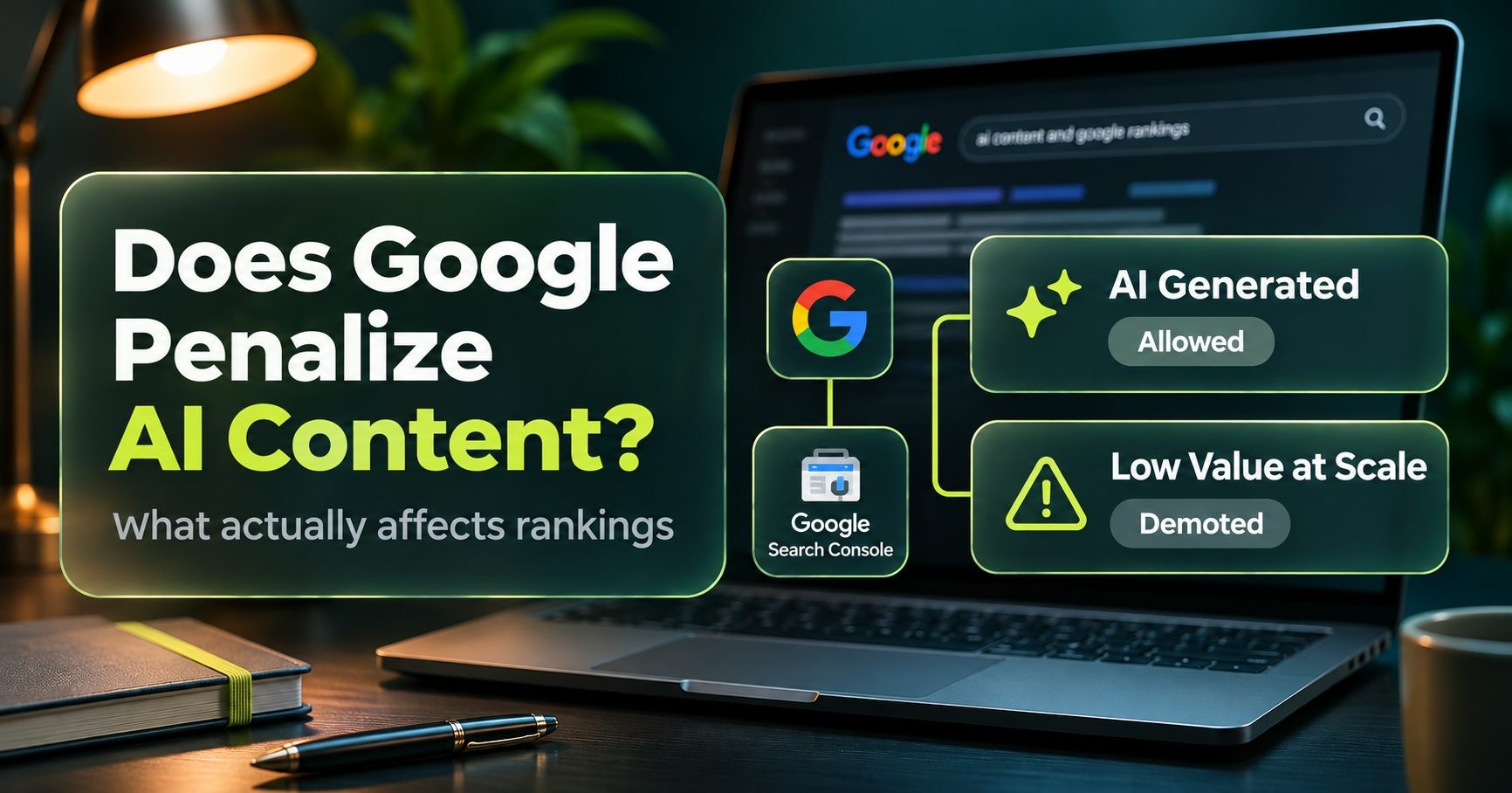
Almost every business that publishes online now uses AI somewhere: to draft blog posts, outline pages, write product descriptions or tidy up copy. And almost every one of them has heard the same warning: Google penalizes AI content. Some sites lost traffic after a core update and blamed AI. Others have stopped using it entirely, just in case.
The real answer is more useful than the rumor. Google does not penalize content simply because AI helped create it. What Google acts against is content that is unhelpful, inaccurate or produced at scale mainly to manipulate rankings, whether a person or a machine wrote it. The catch is that AI makes those exact problems very easy to create by accident, and very fast.
This guide explains what Google's current documentation actually says, why so many sites believe they were penalized for using AI, what really affects rankings, what Google's quality raters look for, whether Google can detect AI content and whether that matters, and how to use AI without putting your rankings at risk.
Quick answer: does Google penalize AI content? No, not for being AI-generated. Google's guidance allows AI content as long as it meets the same standards as any other content. Google does act against low-value content published at scale, inaccurate or misleading content, and spam tactics, regardless of how they were produced. Use AI to help, but make sure every page is accurate, original and genuinely useful.
What Google Actually Says About AI Content
The current guidance
Google's main document on the topic, Google's guidance on using generative AI content, does not ban AI content. It says that if you use generative AI, you should make sure your work meets the standards of Google Search Essentials and its spam policies. In other words, AI content is judged by exactly the same rules as anything else.
The guidance is specific about one responsibility. Because AI models predict likely text rather than look up facts, their output can be wrong. Google asks site owners to "manually factcheck and review all AI-generated content for accuracy and trustworthiness before publishing." That applies beyond the main text, too: Google's guidance mentions reviewing titles, meta descriptions, structured data and image alt text, all of which AI tools often generate.
It also notes that explaining how content was created can help readers, for example by describing how automation was used. And for online stores, Google Merchant Center has its own rules: AI-generated images must carry the IPTC TrainedAlgorithmicMedia metadata, and AI-generated product titles and descriptions must be labeled as AI-generated.
The spam policy that matters: scaled content abuse
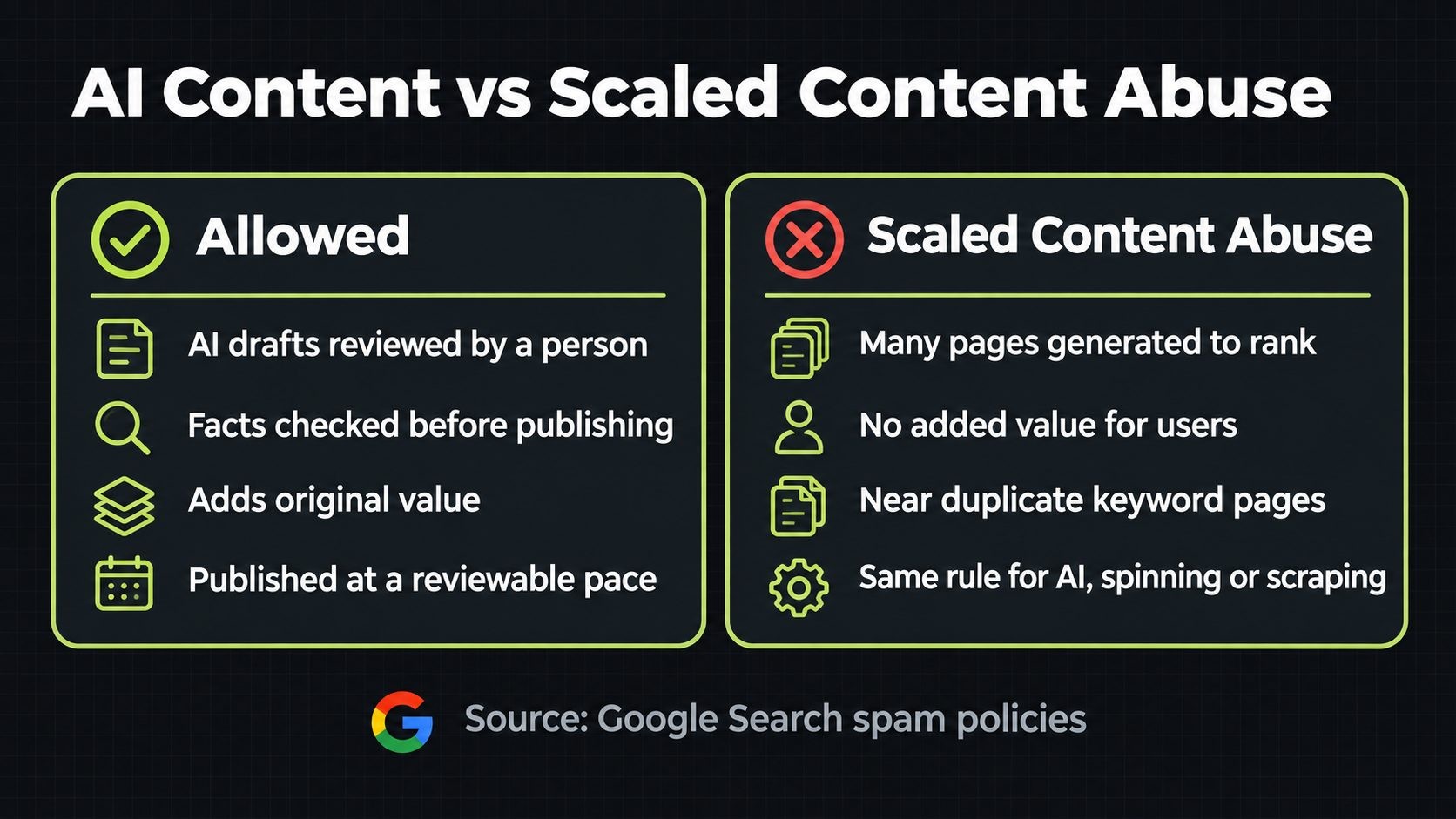
The policy most relevant to AI is in Google's spam policies. Google defines scaled content abuse as "when many pages are generated for the primary purpose of manipulating search rankings." Among its examples is "using generative AI tools or other similar tools to generate many pages without adding value for users."
Read that carefully. The problem is not AI. It is generating many pages, without adding value, mainly to rank. The same policy applies to content produced by cheap freelancers, scraping, spinning or templates. AI simply makes it possible to do at a speed and volume that was not practical before.
The spam policies also cover two related tactics that often appear alongside mass AI publishing: site reputation abuse, where third-party content is published on an established site to borrow its ranking strength, and expired domain abuse, where an expired domain is bought and filled with low-value content to exploit its history.
What Google's AI search guide adds
Google's newer guide to optimizing for its generative AI search features, published in 2026, reinforces the same message from a different angle. It says AI features are rooted in Google's core ranking and quality systems, and its mythbusting section says you do not need to rewrite content for AI or break it into small chunks. The same fundamentals that help pages rank also help them appear in AI Overviews and AI Mode, which is covered in more depth in this guide to getting cited in AI search.
Why So Many Sites Think AI Content Gets Penalized
If Google does not penalize AI content, why do so many site owners believe it does? A few things happened at roughly the same time.
Core updates landed while AI publishing exploded. Many sites started publishing large amounts of AI content in 2023 and 2024, during a period of significant Google updates. When traffic dropped, AI was the obvious suspect, even when the real cause was something else.
The helpful content system was folded into core ranking. In March 2024, Google integrated its helpful content system into its core ranking systems. Signals about whether content is genuinely helpful became part of every core update rather than a separate one, so sites with lots of thin or unoriginal pages could see drops at almost any core update.
Mass-produced sites were hit for scale and thinness. Sites that published hundreds or thousands of AI pages with little editing, little original information and little reason to exist often lost visibility. They were not hit for using AI. They were hit for exactly what the scaled content abuse policy describes, and in some cases they received manual actions visible in Search Console.
Correlation looked like causation. When a site that uses AI loses traffic, it is easy to assume AI caused it. But most sites that use AI also changed other things at the same time: they published more, covered more topics outside their expertise, and spent less time per page. Those changes, not the tool, are what usually hurt.
Detector scores fed the fear. As AI detectors spread, many site owners began running their pages through them and panicking at high scores. A high "AI probability" felt like proof of a problem, even though Google has never said it uses such scores, and the detectors themselves warn that they can be wrong. Worry about the score often replaced the more useful question of whether the page was any good.
Advice spread faster than the documentation. Forum threads, social posts and confident predictions repeated the idea that Google "hates AI" long after Google published guidance saying otherwise. Few people read the primary documents, so the rumor became the accepted wisdom.
The pattern is consistent: the sites that suffered treated AI as a way to publish more, faster. The sites that did fine treated it as a way to publish better.
What Actually Affects Rankings
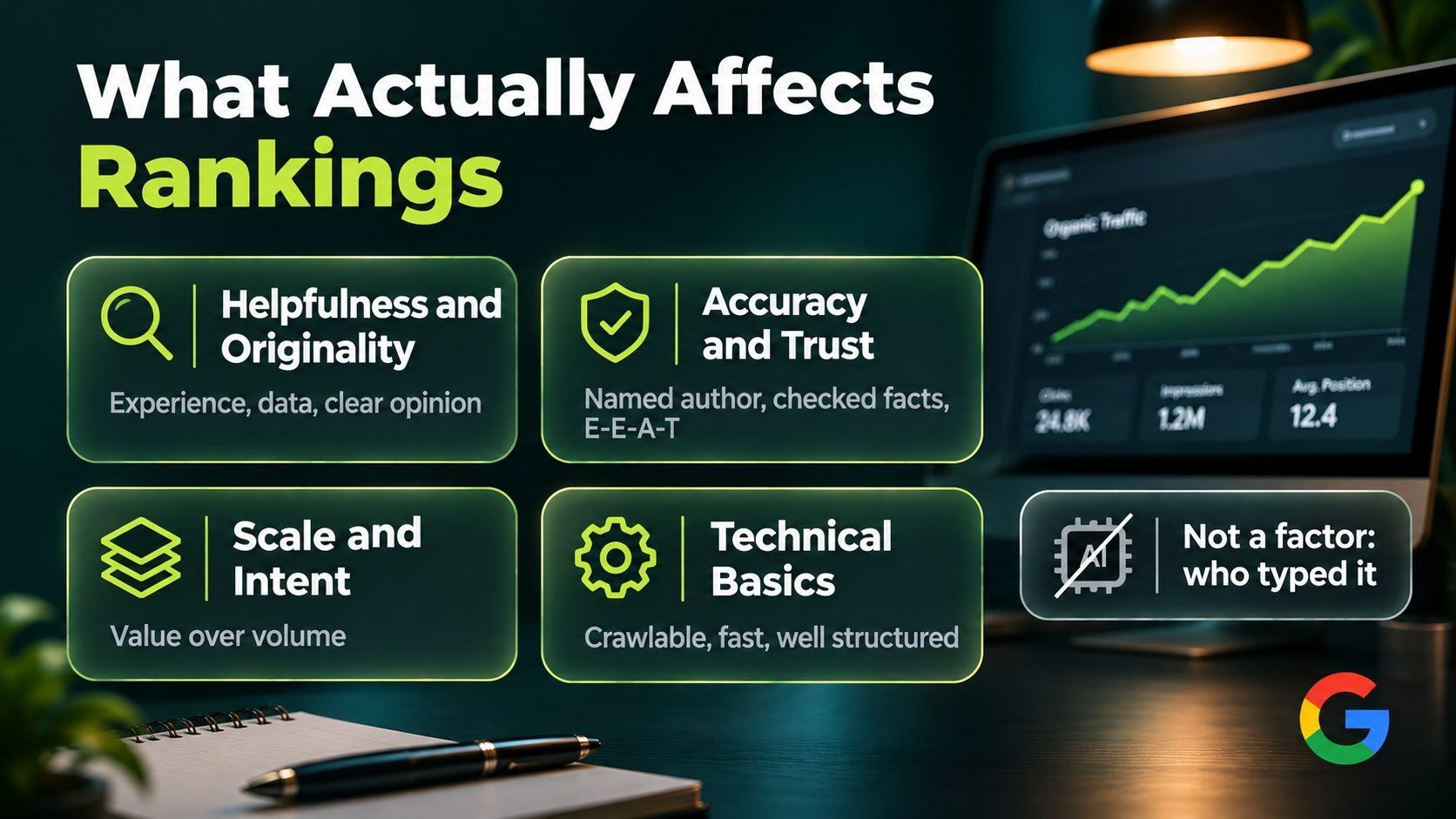
Helpfulness and originality
Google's systems try to reward content that is helpful, reliable and created for people rather than for search engines. In practice, that means content that adds something: first-hand experience, original data, expert judgment, clear examples or a better explanation than what already ranks. AI tools are very good at summarizing what is already published, which is exactly why unedited AI output tends to be generic. If your page says the same thing as the top ten results, in slightly different words, there is little reason for Google to rank it above them.
Originality does not have to mean a new study or a huge dataset. It can be as simple as a worked example from a real job, a photo of the actual problem, a comparison based on your own use of two products, a common mistake you see customers make, or a clear recommendation where other pages only list options. Those details are what make a page worth ranking, and they are exactly what generic AI output leaves out.
Accuracy and trust
AI models can produce confident, fluent text that is simply wrong: invented statistics, outdated rules, made-up quotes and non-existent sources. Publishing those errors damages trust with readers and undermines the signals of experience, expertise, authoritativeness and trustworthiness that Google's quality guidelines describe. The risk is highest on "Your Money or Your Life" topics such as health, finance, legal and safety information, where wrong advice can cause real harm and where Google holds content to a higher standard.
Trust also comes from the page around the content: a named author with real experience, clear sources for claims, an about page, contact details and a site reputation built over time.
Experience is the part of E-E-A-T that AI struggles with most. A model can describe how something is usually done, but it has never done it. Readers and raters can often tell the difference between a page that explains a process in general terms and one written by someone who has clearly been through it, with the specific obstacles, judgment calls and results that only practice provides. An author bio that explains why that person is qualified to write on the topic, and links to their other work, helps make that experience visible.
Scale and intent
How much you publish, and why, matters more than how you write it. Publishing ten genuinely useful pages a month is a normal content strategy. Publishing a thousand near-identical pages targeting every variation of a keyword, with little to say on each, is the kind of activity scaled content abuse describes. If your plan depends on volume rather than value, AI will help you build exactly the kind of site Google tries to demote.
Intent shows up in the shape of a site. A business that publishes guides answering the questions its customers actually ask looks very different from a site that publishes a page for every keyword a tool suggests, whether or not it has anything to say about the topic. Before scaling any content plan, ask whether each page would still be worth publishing if search engines did not exist. If the only reason a page exists is to catch a keyword, it is a weak page however well it is written.
Technical and page-level basics
Content still needs the basics to rank: a clear title and headings, a logical structure, internal links from related pages, fast loading and a page Google can crawl and index. AI does not change any of that. This on-page SEO checklist covers the page-level checks, and this list of technical SEO issues covers problems that can hold back even excellent content.
What Google's Quality Raters Look For
Google employs external quality raters who evaluate search results using a long set of guidelines. In January 2025, Google updated those guidelines with new guidance relevant to AI. According to coverage of the January 2025 rater guidelines update, raters can give the Lowest rating when "almost all Main Content is copied or paraphrased with no effort or added value," and the guidelines connect this to low-effort paraphrased content commonly associated with generative AI.
It is important to understand what raters do and do not do. Their ratings do not directly change rankings for any page. Google uses their feedback to evaluate whether its ranking systems are working as intended. So the guidelines are best read as a detailed description of the kind of content Google wants its systems to reward and demote.
Read that way, the message is clear. Content that takes effort, adds value and reflects real expertise is what Google wants to surface. Content that repackages other people's work with no added value, whether a person or AI did the repackaging, is what it wants to push down.
For anyone using AI, the useful takeaway is to ask the questions a rater would ask. Who wrote this, and why should I trust them? Does the page achieve its purpose? Is there evidence of real effort, original thought or first-hand experience? Would I be satisfied if I landed here from a search? If the honest answer to any of these is no, the page needs more work before it goes live.
Can Google Detect AI Content, and Does It Matter?
Google has never said it ranks content based on whether AI wrote it, and its guidance focuses on quality rather than authorship. Whether Google can detect AI text with confidence is less important than whether the content is useful, because useful AI-assisted content is allowed and useless human-written content is not protected.
AI detectors deserve some caution too. They estimate the probability that text was machine-written by looking at patterns such as predictability and uniformity. That makes them useful as a signal and unreliable as proof. They produce false positives, flagging genuine human writing as AI, and false negatives, missing AI text that has been edited.
The free AI Content Detector from SEO Site Checker is open about these limits. It gives a 0 to 100 AI probability score and states that "no AI detector is fully accurate." Its own page reports that a human-written document from 1776 scored 98.4, while a plain AI explainer scored only 14.4, and it tells users to treat the result as a guide, not proof.
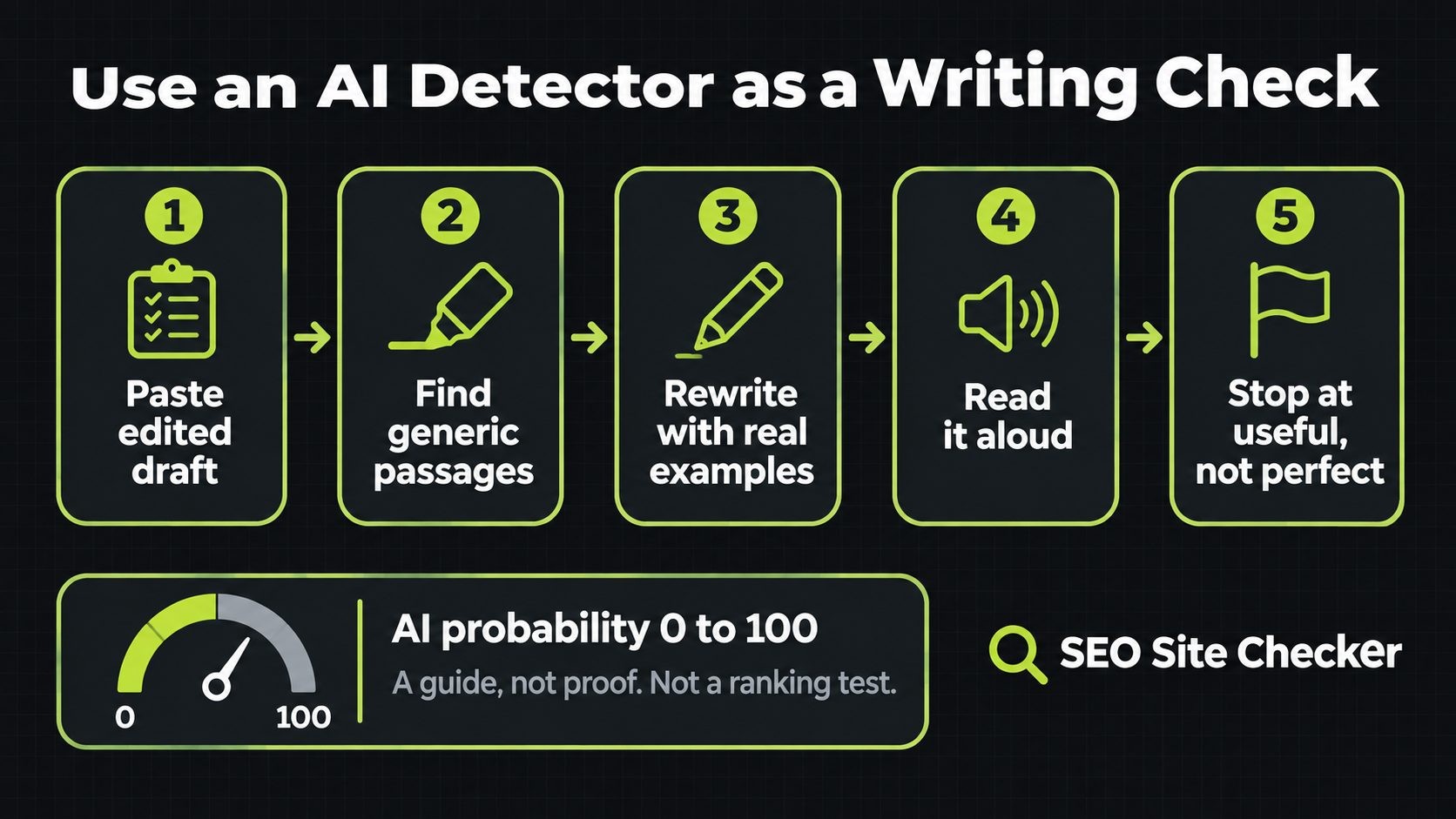
The right way to use any detector is as a writing check before you publish, not as a ranking test. A high score on a passage often means it reads generically: predictable phrasing, no specific examples, no personal view. That is worth rewriting because readers will find it bland, not because Google will punish it. A low score does not mean a page will rank, and a high score does not mean it will not.
A simple way to use a detector as part of editing:
- Paste the draft after your first edit, not the raw AI output, so you are checking what you would actually publish.
- Look at which passages read as machine-written, rather than focusing only on the overall number.
- Rewrite those passages with specific examples, your own view, or details from real experience.
- Read the page aloud once. Generic phrasing is usually easy to hear.
- Do not chase a perfect score. Once the page is accurate, specific and useful, stop editing for the detector.
Detectors work best alongside other checks. A meta tag check, a page speed test and an on-page review tell you far more about whether a page can rank than any AI score. This roundup of free SEO tools covers options for those checks.
Studies that use AI detectors to measure ranking content should be read with the same caution. Rankability's 2026 study of 487 search results, for example, classified 83% of top-ranking pages as human-written using a detector, but the study itself describes its sample as small and detector output as classification evidence rather than proof.
How to Use AI Without Hurting Your Rankings
None of this means you should stop using AI. It means using it where it is strong and keeping people in charge where it is weak. These five practices cover most of the risk.
Use AI for drafts and structure, not final facts
AI is genuinely useful for speeding up the parts of writing that do not require original knowledge: brainstorming angles, drafting outlines, summarizing your own notes, suggesting headings, tightening sentences and catching grammar mistakes. Where it is risky is as the source of facts, figures, rules, quotes and citations. Treat every factual claim in an AI draft as unverified until you have checked it against a primary source.
Add what AI can't
The most reliable way to make AI-assisted content rank is to add the things a language model cannot produce from published text:
- Your experience: what happened when you actually did the thing, including mistakes and trade-offs.
- Your data: results, prices, timelines and examples from your own work.
- Your opinion: a clear recommendation and the reasons behind it.
- Specific examples: real situations your customers face, with the details that make them useful.
A useful test is to ask whether a competitor could produce the same page by typing the same prompt. If the answer is yes, the page needs more of you in it.
For example, an AI draft about choosing a boiler might list the usual factors: size, efficiency, fuel type and cost. A heating engineer can turn that into a page worth ranking by adding which sizing mistakes they see most often, what questions customers forget to ask, and what they would choose for a typical home in their area and why. The structure can come from AI. The value comes from the person who knows the work.
Fact-check everything, including metadata
Follow Google's advice to review all AI-generated content before publishing, and extend that review to the parts readers rarely notice: title tags, meta descriptions, image alt text, structured data and product details. AI tools often fill these in automatically, and errors there can mislead both users and search engines. If you add structured data, validate it and make sure it matches what the page actually shows.
Publish at a human pace, with a clear author
Publish only what you can review properly. A smaller number of strong, accurate pages will outperform a large number of thin ones, and it keeps you well clear of scaled content abuse. Give each piece a named author with relevant experience, link to sources for important claims, and keep an editorial process, even if it is just one careful read and a fact-check before publishing. For local businesses, the same principle applies to service and location pages: a few genuinely useful pages beat dozens of near-identical ones, as covered in this small business SEO checklist.
A light editorial process can be very simple. Write down who reviews each piece, what they check (facts, links, claims, tone, metadata) and who signs it off. Keep a short list of trusted primary sources for your topic so fact-checking is quick. Then hold every page to that process, whether a person or AI produced the first draft.
Label AI images and product data for Merchant Center
If you sell online through Google Merchant Center, follow its specific rules. AI-generated images need the IPTC TrainedAlgorithmicMedia metadata, and AI-generated product titles and descriptions must be labeled as AI-generated. These are platform requirements rather than ranking factors, but ignoring them can cause product disapprovals. Check the current Merchant Center documentation before uploading AI-generated product data, because these platform rules change more often than Search guidance, and make sure your image tools preserve the metadata rather than stripping it on export.
Signs Your AI Content Is Hurting You (and How to Fix It)
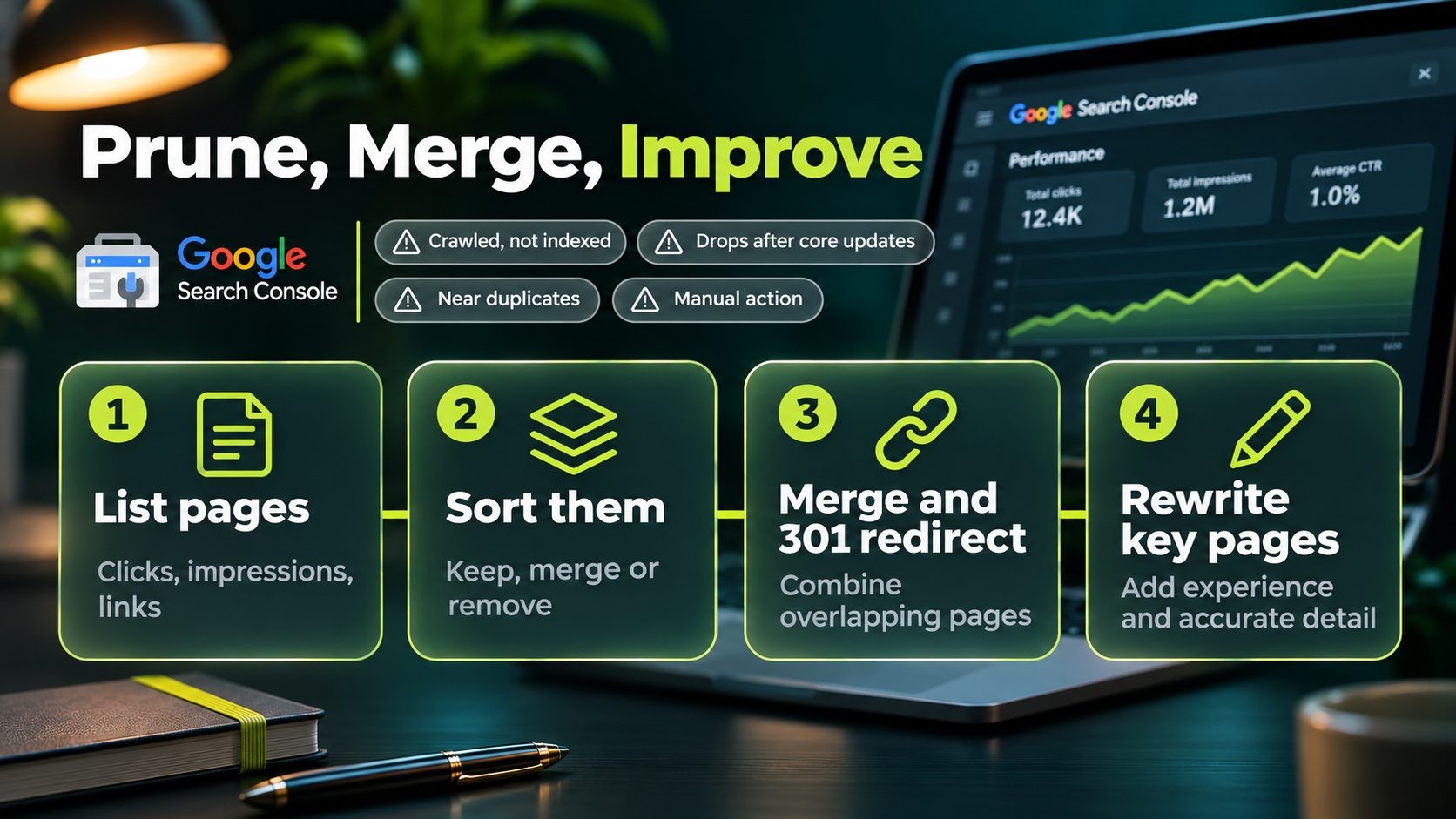
If you have published a lot of AI-assisted content, watch for these signs:
- Many pages stuck as "Crawled - currently not indexed" in Search Console. Google visited them and decided they were not worth indexing, often because they add little beyond existing pages.
- Traffic drops that line up with core updates, especially across sections with lots of similar pages.
- Many near-duplicate pages targeting slight keyword variations.
- A manual action in Search Console mentioning spam or scaled content.
- Low engagement: visitors arriving and leaving quickly, rarely visiting another page or converting.
The fix is rarely to delete AI from your process. It is to improve or remove the weak pages. A practical clean-up usually follows four steps:
- List your pages with their clicks, impressions and backlinks from Search Console and any link tool you use.
- Sort them into groups: keep and improve, merge, or remove. Pages with traffic or links are worth keeping. Pages that overlap with stronger pages are merge candidates. Pages with no traffic, no links and no clear purpose are removal candidates.
- Merge carefully. Combine the useful parts of overlapping pages into one stronger page, then 301 redirect the old URLs to it so you keep any value they had.
- Rewrite your most important pages with real experience, accurate details and a clear point of view, starting with those closest to earning traffic. This guide to site architecture for SEO explains how to consolidate and organize pages without losing what already works. Then slow down publishing so every new page meets the same standard.
Recovery takes time. Improvements are usually reflected over weeks or months, often around later core updates, rather than immediately.
An AI-Assisted Publishing Checklist
Run through this before publishing any page that AI helped create:
- The page answers a real question your audience has
- It adds something the current top results do not
- It includes first-hand experience, data or a clear opinion
- Every fact, figure and quote has been checked against a primary source
- No invented statistics, studies or citations
- Title tag and meta description reviewed and accurate
- Image alt text and structured data reviewed and valid
- A named author with relevant experience
- Sources linked for important claims
- Not a near-duplicate of another page on your site
- Linked from and to related pages on your site
- Read through once by a person before publishing
FAQs
Conclusion
Google does not penalize content for being AI-generated. It rewards content that is helpful, accurate and original, and it acts against content that is thin, misleading or produced at scale to manipulate rankings. AI changes how quickly you can create both kinds. That is the real risk, and the real opportunity.
The safest approach is simple. Use AI to speed up drafting and editing, then add the experience, data and judgment only you can provide. Fact-check everything, including the metadata, publish at a pace you can review properly, and put a real author behind every page. Do that, and the question stops being "AI or human" and becomes the only one that has ever mattered to rankings: is this page genuinely useful? Start with your most important pages, check them against the checklist above, and improve one at a time.
Check your drafts before you publish. Paste a draft into the free AI Content Detector to spot passages that read generic or machine-written, then rewrite them with your own examples. Treat the score as a writing check, not a ranking test.
Get new posts by email
New guides and alerts, sent when they are published. No spam. Unsubscribe anytime.



Comments (0)