- Updated
- Khurram Shahzad
- Security Alerts
- 639
- 0
Updated: November 11, 2026. This is a developing story, and we will update this guide as Binance publishes its full investigation.
Latest update, November 1: Binance says about 90% of the affected assets have now been replenished, up from 80%, and ten major tokens including BTC, ETH, USDT, BNB, SOL and USDC are fully backed. A new Proof of Reserves snapshot was taken on October 31, and Binance says it is on track to reopen withdrawals on November 1. See what this means for your money.
The Binance hack is now the largest cryptocurrency theft on record. In a burst of activity that lasted roughly 20 minutes, attackers drained an estimated $6.3 billion from Binance's hot wallets across about ten blockchains. And according to Binance's first findings, it may have started with something surprisingly ordinary: one engineer's laptop.
Binance says a compromised DevOps engineer's laptop gave the attacker access to an internal service that could submit withdrawals. Blockchain analysts have linked the theft to North Korea's TraderTraitor hacking unit. About $3 billion has been frozen, and Binance has promised to cover every customer loss.
In this guide, you will learn what happened, how a single laptop could lead to a $6.3 billion theft, who is suspected, where the money went, whether your funds are safe, and what every company can learn from it.
Binance Hack at a Glance
| Detail | Information |
|---|---|
| Estimated impact | About $6.3 billion (Binance's estimate) |
| Date | October 29 to 30, 2026 |
| What was hit | Binance hot wallets across about 10 blockchains |
| Speed | Most funds moved within about 20 minutes (TRM Labs) |
| Initial entry point | A compromised DevOps engineer's laptop (preliminary) |
| Private keys leaked? | No evidence, according to Binance |
| Frozen so far | About $3 billion |
| Suspected attacker | North Korea's TraderTraitor unit (TRM Labs, Chainalysis); not confirmed by Binance or any government |
| Customer losses | Binance says it will cover all losses from its SAFU fund and company funds |
| Funds reserved | Over $6.34 billion, including $5 billion in the exact impacted tokens (Binance email to users) |
| Recovery | About 90% of affected assets replenished as of November 1; ten major tokens fully backed |
| Proof of Reserves | New snapshot taken October 31; verifiable proof expected around November 3 |
| Withdrawals | Suspended; Binance says it is on track to reopen them on November 1. Deposits unaffected |
| Binance.US | Not affected; a separate, independent platform |
Binance Hack Timeline
Here is how the attack unfolded, based on Binance's statements and blockchain analysis.
- October 27. Binance says it fended off several North Korea-linked attacks in the past week, tied to a campaign of fake job interviews. It reports no compromised systems.
- October 28. Small withdrawals from the Tornado Cash mixer fund the attacker's operating wallet, at least 36 hours before the theft.
- Early October 29. The attacker deploys its code, tests it on two smaller wallets and rehearses the final version on a third, more than four hours before the main drain.
- October 29. The main attack hits. About $6.36 billion leaves Binance wallets across ten blockchains, most of it within roughly 20 minutes. Binance suspends deposits and withdrawals.
- Within hours. Tether and Circle start freezing stolen stablecoins. Tether's CEO says more than 1.5 billion USDT has been frozen, and Circle's CEO says more than 800 million USDC.
- October 30, 02:25 UTC. Binance publishes its first detailed update. It estimates the impact at about $6.3 billion, points to a compromised DevOps engineer's laptop, says about $3 billion has been frozen, and promises to cover all losses.
- October 30. TRM Labs attributes the attack to TraderTraitor "with high confidence", and Chainalysis agrees. Binance co-CEO Richard Teng says the attack was more complex than one engineer's permissions, and Binance confirms it has found additional points of breach. Binance clarifies that deposits were not affected, and expects withdrawals to reopen within about 48 hours.
- October 31. Binance emails users that their funds are safe. It says it has reserved over $6.34 billion in company funds to cover the incident, $5 billion of it in the exact impacted tokens, and has revoked authorization on the affected addresses while it rebuilds its withdrawal service.
- October 31. Binance.US, the separate US exchange, says it was not affected. "We are a separate, independent platform, and customer funds and services are secure and operating normally," it said, as reported by ABC News.
- November 1. In a second email to users, Binance says about 90% of affected assets have been replenished, up from 80%. BTC, ETH, USDT, BNB, SOL, USDC, XRP, USD1, RLUSD and ZEC are backed at 100%, and it is buying the remaining, less liquid tokens through market and OTC channels. It also takes a new Proof of Reserves snapshot and says withdrawals remain on track to reopen on November 1.
How the Binance Hack Worked
To understand the Binance hack, it helps to know how an exchange moves money.
Hot wallets vs cold wallets
Exchanges keep most customer funds in cold wallets, which are offline and hard to reach. A smaller share sits in hot wallets, which are online so the exchange can process withdrawals quickly. The Binance hack targeted these hot wallets.
The attack chain, step by step
Based on Binance's statement and blockchain analysis, the attack appears to have followed this path:
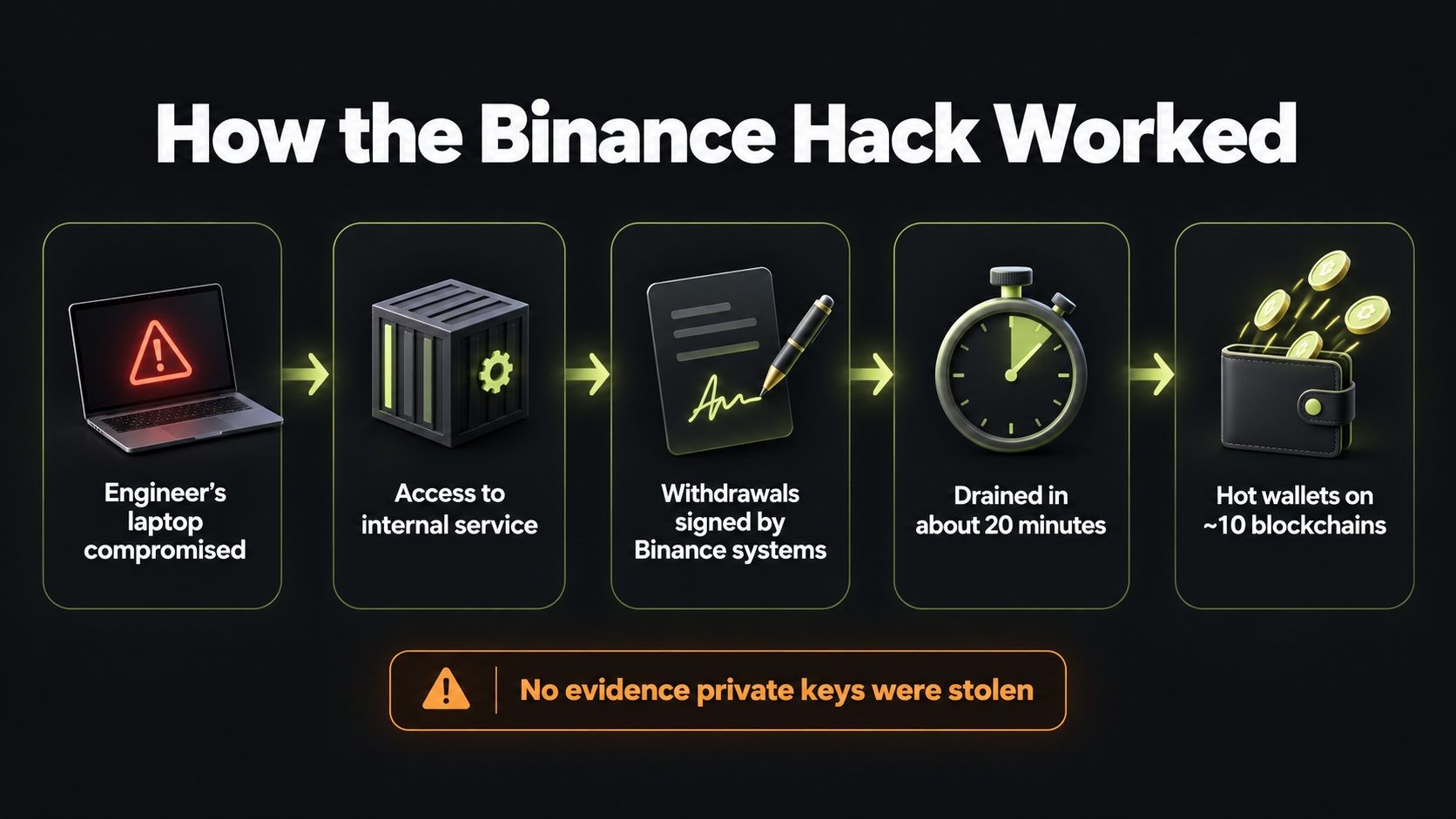
- A laptop was compromised. An attacker gained control of a DevOps engineer's work laptop. DevOps engineers build and run the systems that keep software working, so they often have access to sensitive infrastructure.
- The attacker reached a service container. From the laptop, the attacker accessed an internal service that was allowed to request withdrawal transactions.
- Withdrawals were signed by Binance's own systems. Binance says it found no evidence that wallet private keys leaked. That matters: the attacker did not need to steal the keys, because Binance's own signing systems approved the withdrawals. TRM Labs describes this as a compromise of Binance's hot wallet signing infrastructure.
- Everything was prepared in advance. According to TRM, signatures were collected ahead of time and executed in one burst. On Ethereum, a single transaction carried 50 authorizations signed by a Binance hot wallet.
- The drain took about 20 minutes. Funds left wallets on about ten blockchains, including Ethereum, Bitcoin, Tron, Solana and the XRP Ledger, mostly within a 20-minute window.
In plain terms, the attacker did not crack Binance's cryptography. They got inside the systems that are trusted to move money and made those systems do the work.
The Laptop Question: What We Know and What We Do Not
The headline detail of the Binance hack is the laptop. But it is important to separate what Binance has confirmed from what people are assuming.
What Binance has said:
- Its initial investigation suggested the incident "may involve" a compromised DevOps engineer's laptop.
- That laptop allowed access to a service container that could submit unauthorized withdrawals.
- Later, Binance said its investigation had uncovered additional points of breach, and called it a "complex attack".
- Co-CEO Richard Teng said the attacker "did not simply use one engineer's permissions" and that this "was not a single 'one-click' action".
What Binance has not said:
- How the laptop was compromised.
- What permissions the engineer's role had.
- Which other controls failed, and what the additional breach points were.
What to be careful about: some people online are connecting the Binance hack to other incidents from the same week, including a tampered developer tool extension, and to the fake job interview campaign Binance blocked days earlier. There is no public evidence linking the Binance hack to any of these. Until Binance publishes its technical post-mortem, the laptop remains a preliminary starting point, not a complete explanation.
Who Is Behind the Binance Hack? North Korea and TraderTraitor
Binance has not named an attacker. But blockchain investigators are pointing in one direction.
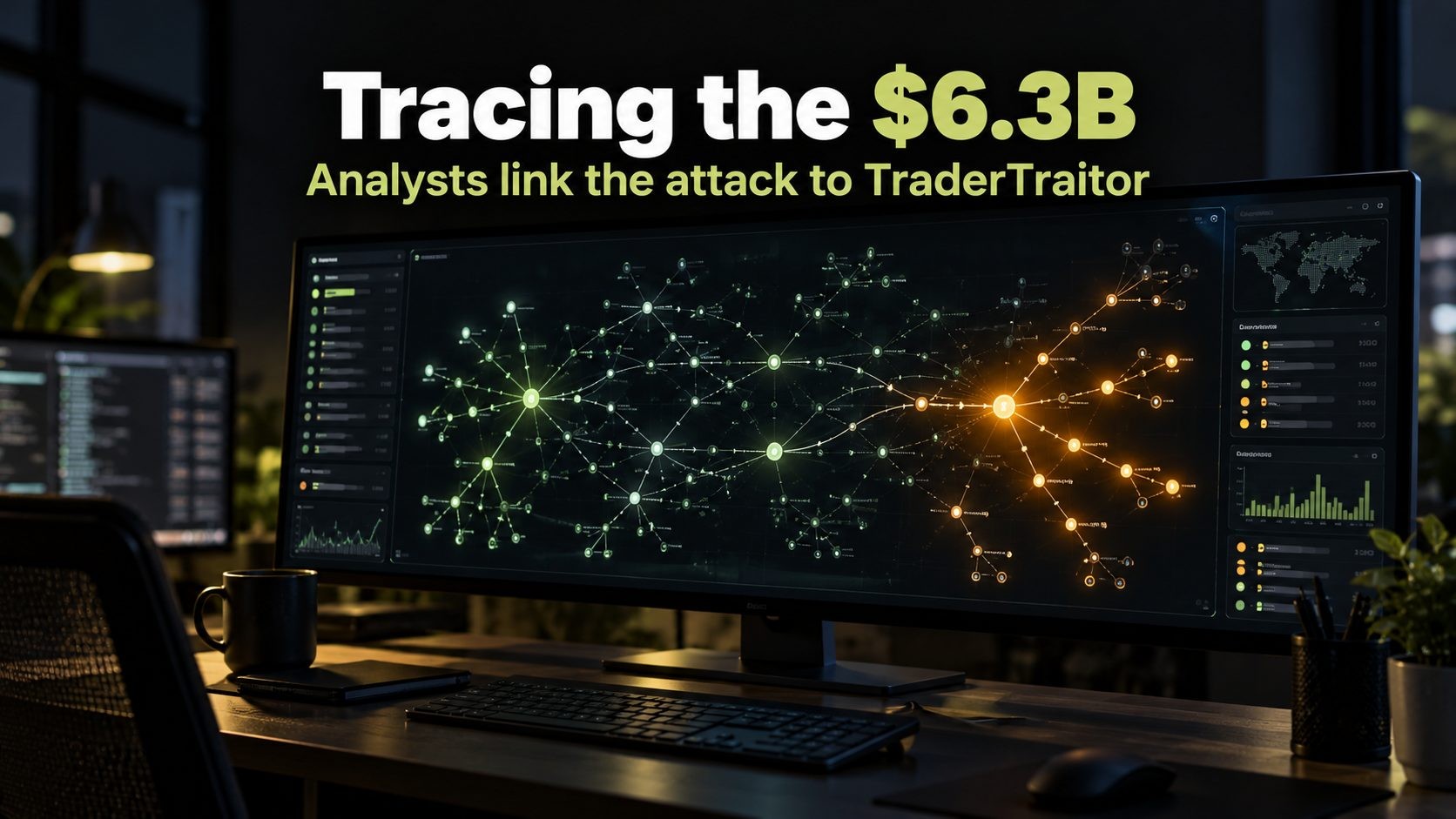
TRM Labs attributes the Binance hack to TraderTraitor "with high confidence". Chainalysis reached the same conclusion, and on-chain investigator ZachXBT called it "likely Lazarus". No government has formally attributed the attack yet.
What is TraderTraitor?
TraderTraitor is the FBI's name for a North Korean state-sponsored hacking operation, also tracked as Jade Sleet and Slow Pisces. It is widely treated as part of the broader Lazarus Group. It has a long record of exchange thefts:
- DMM Bitcoin (May 2024): US and Japanese authorities linked the group to a $308 million theft.
- Bybit (February 2025): the FBI attributed the $1.5 billion theft to TraderTraitor within five days.
The group usually gets in through people, not code. Its operators pose as recruiters or business contacts and persuade employees to run malicious software.
Why investigators point to North Korea
According to analysis linking the Binance hack to TraderTraitor, several signs match earlier North Korea-linked heists:
- The attacker's wallet was funded through Tornado Cash more than 36 hours before the theft.
- The attack was staged and rehearsed, tested on smaller wallets before the main drain.
- Signatures were gathered in advance and fired in one burst.
- Chainalysis says it saw funds from September's Bitget exploit mixed in with the stolen Binance funds.
Following the Money: What Was Frozen and What Was Not
The Binance hack moved fast, but so did the response. Stablecoin issuers can freeze tokens on-chain, and they did.
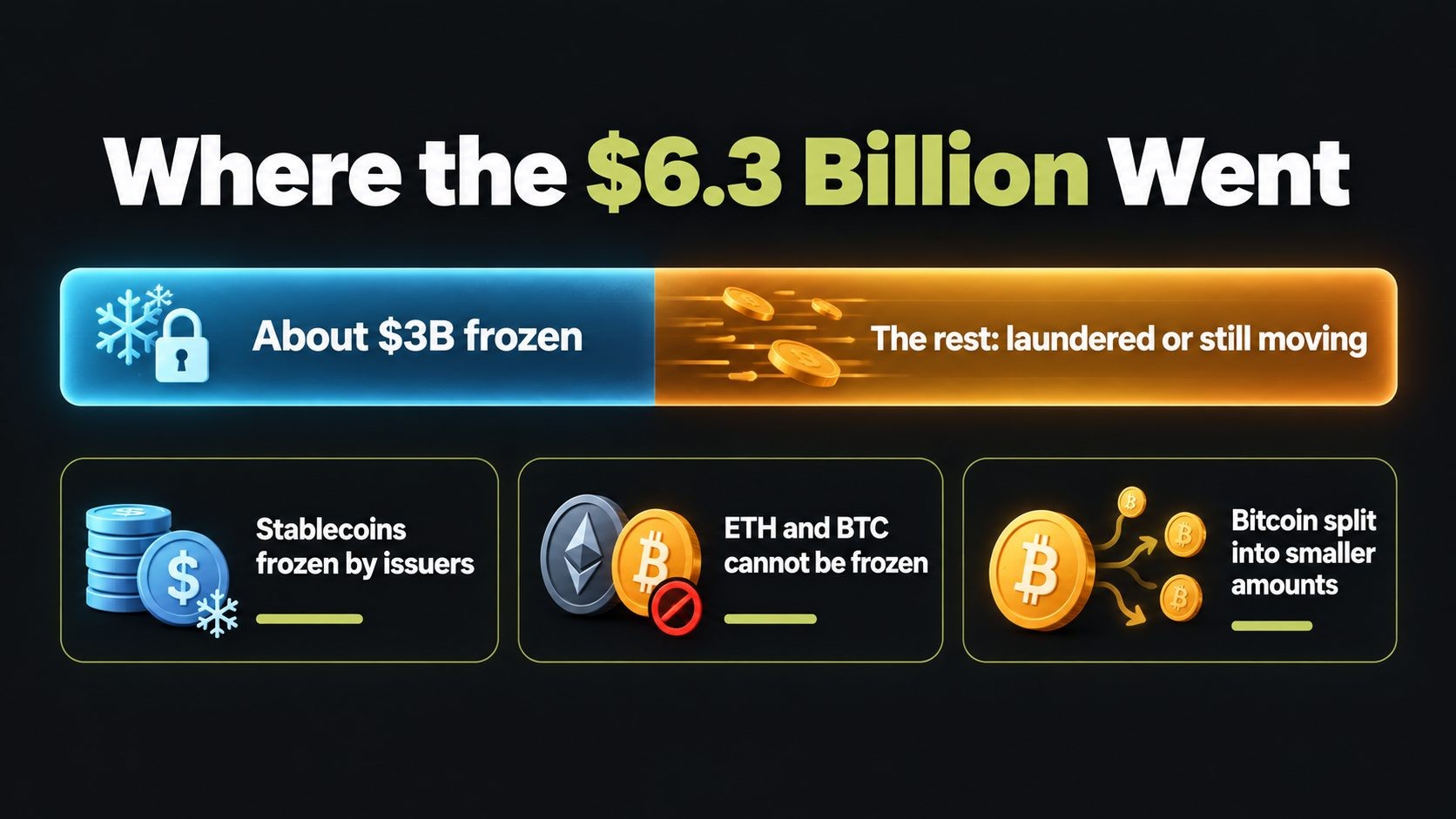
- Tether CEO Paolo Ardoino said more than 1.5 billion USDT was frozen.
- Circle CEO Jeremy Allaire said more than 800 million USDC was frozen, in coordination with law enforcement.
- Binance puts the total frozen so far at about $3 billion.
The rest is harder to stop. Assets like ether and bitcoin cannot be frozen by an issuer. According to analysts, the attacker sold about 325 million USDT for roughly 122,300 ETH before it could be frozen, and is splitting about 18,270 BTC into smaller pieces, a common laundering step. Analysts estimate about $2.4 billion in ETH and BTC is currently out of reach.
The Forbes report on the Binance hack notes the attacker now holds more bitcoin than Binance's own SAFU emergency fund.
Is Your Money Safe on Binance?
This is the question most Binance users are asking. Here is what Binance has said, and what you can do.
What Binance has promised:
- "User funds are safe." Binance says it will cover all losses from its SAFU fund and company funds.
- In an email to users on October 31, Binance said it has reserved over $6.34 billion in company funds to cover the incident, with $5 billion held in the exact impacted token assets.
- Deposits and normal platform activity are unaffected.
- It has revoked authorization on the affected addresses and is rebuilding its withdrawal service before reopening withdrawals.
- By November 1, about 90% of affected assets had been replenished. Ten tokens (BTC, ETH, USDT, BNB, SOL, USDC, XRP, USD1, RLUSD and ZEC) are fully backed, and the remaining 10% is made up of less liquid tokens Binance is still buying.
- The money came from a partial use of the SAFU fund, part of Binance's Futures Insurance Fund, and Binance's own corporate treasury.
- A new Proof of Reserves snapshot was taken on October 31 at 00:00 UTC. Binance says the zero-knowledge proof takes 40 to 50 hours to generate, so holders of those ten tokens should be able to verify their balances are backed at least 1:1 from around November 3.
- It will publish a full technical post-mortem once the investigation is complete.
Can Binance afford it? The reserve Binance describes is larger than the full estimated impact, and most of the gap has already been refilled. For context, CryptoQuant analyst Julio Moreno estimated about $2.9 billion remained unrecovered, more than double the roughly $1.17 billion SAFU fund, which is why Binance is also drawing on company funds. Forbes puts Binance's custody holdings at roughly $144 billion.
Using Binance.US? It is a separate company. Binance.US says it was not affected, and that its customer funds and services are operating normally.
What you should do now:
- Rely only on official Binance channels for updates. Scammers often launch fake "refund" or "recovery" sites after big hacks.
- Never share your password, 2FA codes or seed phrase with anyone claiming to help recover funds. Binance says it will never ask for them.
- Set up Binance's anti-phishing code in your account settings. Genuine Binance emails will then show your personal code, so fake "refund" emails are easy to spot.
- Turn on strong 2FA, ideally with an authenticator app or a hardware security key, not SMS.
- Review your API keys and withdrawal allowlist in your Binance account, and remove anything you do not recognize.
- Check the new Proof of Reserves once the proof is ready, expected around November 3, and avoid panic moves while withdrawals are paused.
Binance vs Bybit: The Two Biggest Crypto Hacks Compared
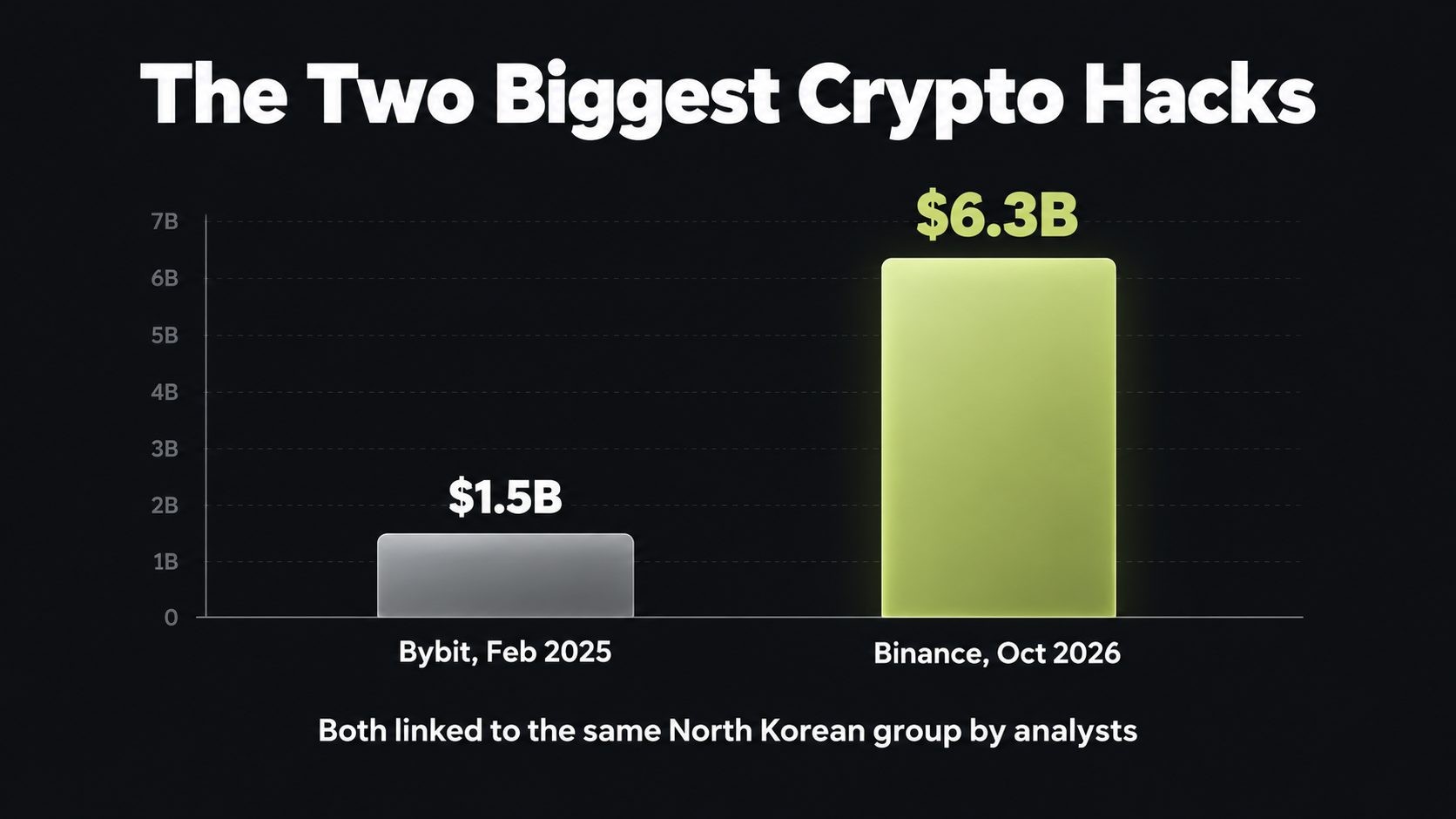
| Bybit (February 2025) | Binance (October 2026) | |
|---|---|---|
| Amount stolen | About $1.5 billion | About $6.3 billion (Binance estimate) |
| Suspected attacker | TraderTraitor (FBI attribution) | TraderTraitor (TRM Labs, Chainalysis; not yet official) |
| Entry point | A compromised developer machine at a wallet software provider | A compromised DevOps engineer's laptop, plus additional breach points |
| Keys stolen? | No; signing process manipulated | No evidence; signing infrastructure abused |
| Customer losses | Covered by Bybit | Binance promises to cover all losses |
The pattern is striking. The two largest exchange thefts in history both appear to trace back to an engineer's computer, not to broken cryptography. In both cases, attackers did not need the keys. They needed access to the systems trusted to use them.
Lessons: Why Developer Laptops Are Now the Top Target
The Binance hack shows that the most valuable target in a company is often not the server. It is the laptop of the person who can reach the server.
This is part of a wider trend. In recent weeks alone, we have covered the Claude Code extension backdoor, a tampered developer tool that tried to plant SSH backdoors, the AuthMask token theft flaw, and the UpdraftCentral backdoor attack. These are separate incidents with no confirmed connection to Binance, but they share a theme: attackers are going after developers and the tools they trust. And AI-automated attacks like CyberStrikeAI are making that faster.
What every company with sensitive systems should do:
- Treat engineer laptops as critical infrastructure. Use endpoint detection, full-disk encryption and strict software controls on every machine with production access.
- Never let one machine hold the keys to the kingdom. Separate the systems engineers use day to day from the systems that can move money or change production.
- Require more than one approval for high-value actions, enforced by independent systems, so one compromised account cannot act alone.
- Use least privilege and short-lived access. Grant production access only when needed, and remove it automatically afterwards.
- Train staff on recruitment scams. Fake job interviews that ask candidates to run code are a known North Korean tactic.
- Monitor for unusual signing and withdrawal patterns, including test transactions and rehearsals like those seen before this attack.
For a step-by-step version of these controls, work through our developer laptop security checklist.
If you want an outside view of how exposed your own team's machines are, a security review for your business is a practical place to start.
This alert is part of our website security for small business guide, which puts every 2026 incident into a layer-by-layer plan you can follow.
Not sure if this affects you? I've recovered 50+ attacked websites. Request a security review.
Frequently Asked Questions
Conclusion
The Binance hack shows that a $6.3 billion theft can begin with one laptop. The cryptography held. What failed was the trust placed in the people and machines allowed to move money.
Binance has promised to cover losses, about $3 billion is already frozen, and around 90% of the affected assets have been replenished. The full story will come with Binance's post-mortem, and we will update this guide when it arrives. Until then, read more cybersecurity guides on the blog, or talk to us about securing developer machines.
Get new posts by email
New guides and alerts, sent when they are published. No spam. Unsubscribe anytime.



Comments (0)