
CyberStrikeAI shows what a cyberattack looks like when one person can command an army of AI workers. In October 2026, a single attack platform split its work across 44 AI agents. Together, they scanned for targets, tested weaknesses, broke in, stole data and even wrote a neatly formatted report for every victim.
Researchers at TrendAI (Trend Micro) found that the CyberStrikeAI campaign targeted at least 19 organizations, including at least 16 in Japan. It is the same open-source tool that was linked earlier this year to the hacking of more than 600 Fortinet FortiGate firewalls around the world.
Here is the part that matters most for your business: no new vulnerabilities were needed. AI did not invent a magic new way in. It simply found the old, unlocked doors faster than any human team could. That means the defenses that work are ones you can put in place today.
In this guide, you will learn what CyberStrikeAI is, how its 44 agents worked together, what happened in Japan, and a practical checklist to protect your business from AI-automated attacks.
CyberStrikeAI at a Glance
| Detail | Information |
|---|---|
| What it is | Open-source, AI-native security testing platform written in Go |
| Developer | GitHub user Ed1s0nZ (China-based) |
| Intended use | Authorized penetration testing |
| Built-in tools | More than 100 security tools |
| AI models supported | OpenAI-compatible APIs, including GPT, Claude and DeepSeek |
| First major abuse | FortiGate campaign, January 11 to February 18, 2026 (600+ devices, 55+ countries) |
| Japan campaign | October 2026, 44 AI agents, at least 19 organizations targeted |
| Countries targeted (Japan campaign) | Japan, Taiwan and Hong Kong |
| Key researchers | TrendAI (Japan); Amazon Threat Intelligence and Team Cymru (FortiGate) |
| New vulnerabilities used | None reported |
What Is CyberStrikeAI?
CyberStrikeAI is a free, open-source platform that lets an AI model plan and run security tests on its own. Instead of a human typing every command, the AI chooses which tools to run, reads the results, and decides what to do next.
Tools like this have a legitimate purpose. Penetration testers, the "ethical hackers" companies hire, use them to find weaknesses before criminals do. CyberStrikeAI's own project page describes it as a platform for authorized security testing.
What makes CyberStrikeAI different from older security tools is how much it automates. You can describe a goal in plain language, and the AI picks from more than 100 integrated tools to reach it. It also supports the Model Context Protocol (MCP) for connecting tools, keeps a knowledge base, visualizes attack chains and generates reports automatically.
That is exactly the problem. The features that help a defender test a network in an afternoon also help an attacker break into dozens of networks at once. Security experts call this a dual-use tool. CyberStrikeAI has thousands of stars and forks on GitHub, which means copies have spread widely and cannot be pulled back.
CyberStrikeAI vs CyberStrike
Do not confuse CyberStrikeAI with a separate open-source project called "CyberStrike". They have similar names but are different tools. The campaigns in this article involve CyberStrikeAI, the Go-based platform published by Ed1s0nZ.
Who Built CyberStrikeAI, and Why Researchers Are Concerned
CyberStrikeAI is maintained by a China-based developer who uses the alias Ed1s0nZ on GitHub. Will Thomas, a researcher at the threat intelligence firm Team Cymru, assessed that the developer has some ties to the Chinese government. Researchers also noted that the tool was shared with Knownsec's 404 "Starlink" project in late 2025.
That background is worth knowing, but it needs context. The origin of an open-source tool does not tell you who is using it. In the FortiGate campaign, Amazon described the attacker as a Russian-speaking, financially motivated criminal, not a government team.
The real concern is simpler. Once a powerful attack platform is public and free, anyone can download it, from a skilled state hacker to a low-level criminal looking for easy money.
The First Warning: CyberStrikeAI and the FortiGate Campaign
Before Japan, CyberStrikeAI made headlines for a very different campaign.
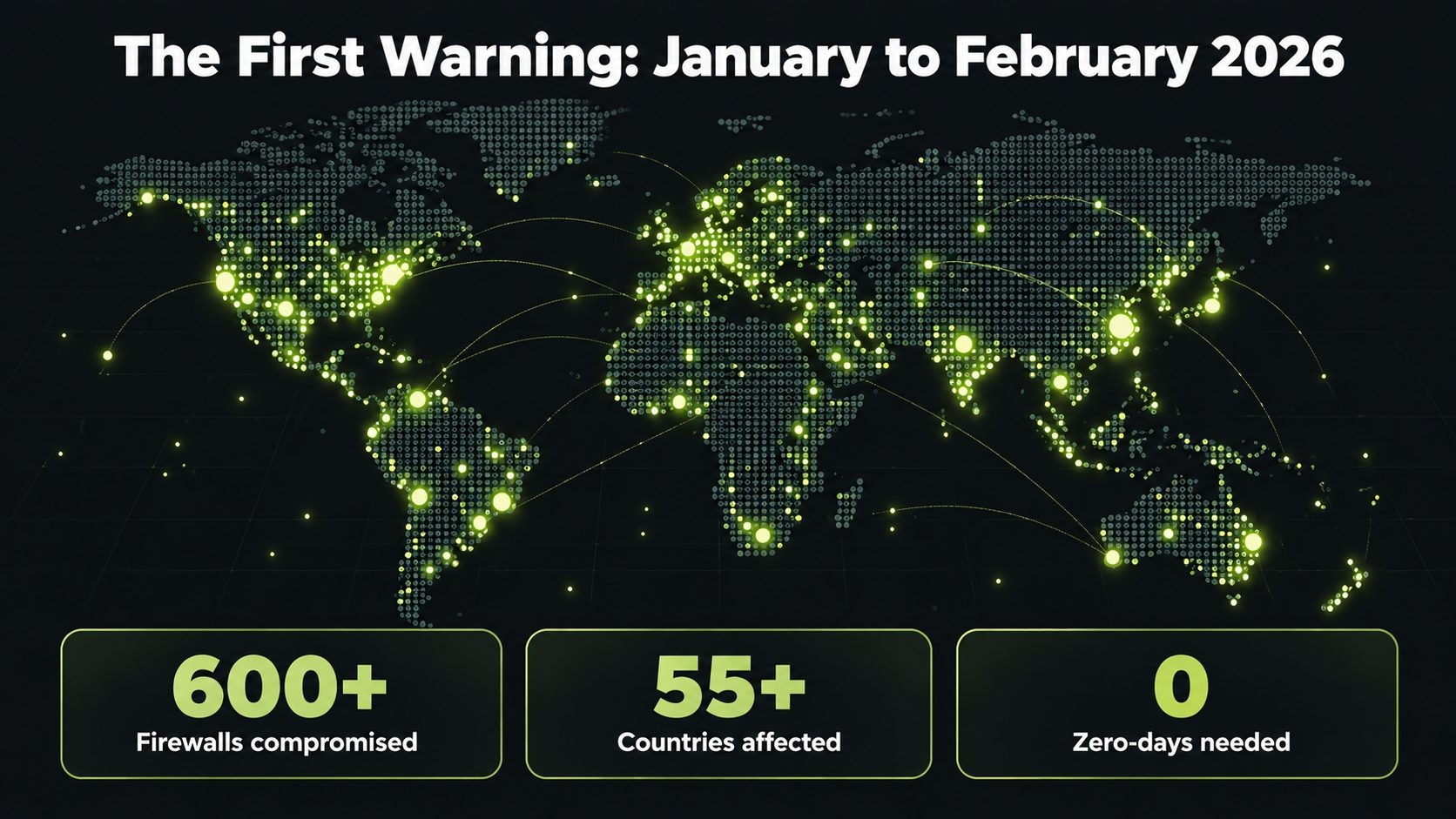
Between January 11 and February 18, 2026, an attacker compromised more than 600 Fortinet FortiGate firewalls across more than 55 countries. According to the Amazon Threat Intelligence report on the FortiGate campaign, the person behind it was a Russian-speaking, financially motivated actor with only low-to-medium technical skill. What made the difference was AI. Amazon described the attacker as significantly augmented by generative AI services.
The method was surprisingly simple. No FortiGate zero-day vulnerabilities were exploited. Instead, the attacker went after firewall management interfaces left exposed to the internet and accounts protected by weak credentials.
So where does CyberStrikeAI come in? In Team Cymru's analysis of CyberStrikeAI servers, researchers found a CyberStrikeAI service banner running on port 8080 on the attacker's server (212.11.64[.]250), along with network traffic between that server and targeted FortiGate devices. Team Cymru went on to track 21 unique IP addresses running CyberStrikeAI between January 20 and February 26, 2026. Most were hosted in China, Singapore and Hong Kong, with others in the United States, Japan and Switzerland.
The lesson from the FortiGate campaign was clear, and it would repeat in Japan. AI allowed a modestly skilled attacker to work at the scale of a much larger and more experienced team.
The Japan Campaign: How Researchers Found It
Eight months later, CyberStrikeAI showed up again, this time running a far more automated operation.
TrendAI researchers Bakuei Matsukawa and Joseph C. Chen uncovered it in an unusual way. Attackers had left parts of their servers publicly accessible, in what security researchers call open directories. Inside, they found reconnaissance and attack tools, scripts, target lists, results, logs and command histories. The exposed management console was written in Simplified Chinese.
TrendAI's research on AI-driven attacks targeting Japan actually covers three separate campaigns. They range from operations run mostly by hand by skilled operators to platforms where AI agents automated the entire workflow. The CyberStrikeAI campaign was the most automated of the three.
It is worth noting what the researchers did not claim. TrendAI found no evidence that the three campaigns were run by the same operator, and it did not attribute the CyberStrikeAI activity to a specific group or country.
How 44 AI Agents Worked Together
This is what sets the CyberStrikeAI campaign apart. Instead of one hacker working through targets one by one, the platform behaved like a team of specialists.
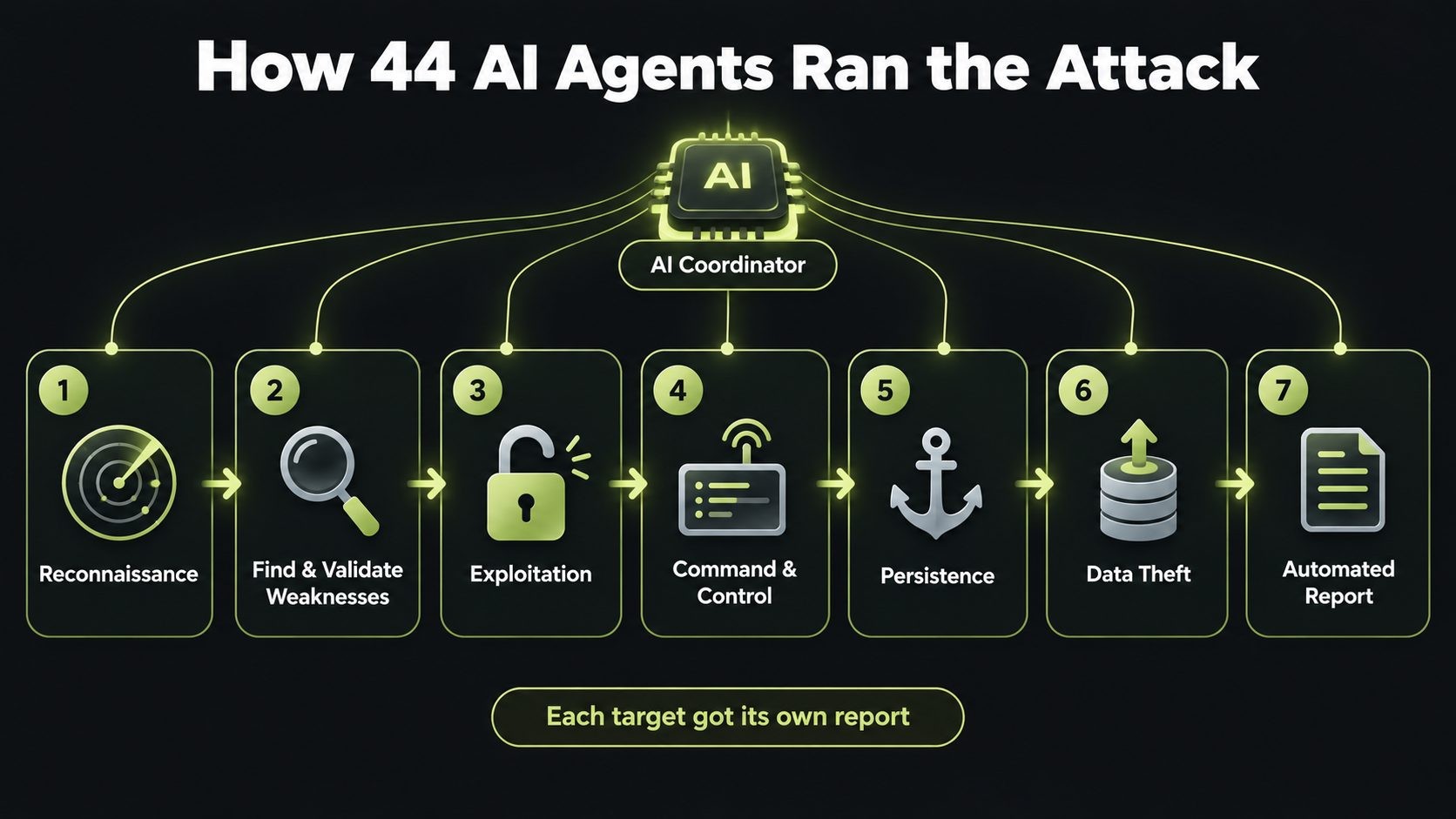
Think of each AI agent as a worker with a single job. A coordinator hands out tasks, collects the results and passes them to the next specialist. Records in the attacker's data, such as an entry labeled "credential-search agent 8/44", showed that CyberStrikeAI was configured to split its work among 44 agents.
Together, those agents automated the full attack lifecycle as a repeatable workflow:
- Reconnaissance. Agents mapped targets and what they exposed to the internet, such as websites, admin pages and services.
- Vulnerability discovery and validation. Instead of guessing, agents tested which weaknesses were real and usable.
- Exploitation. Agents used those weaknesses to break in.
- Command and control (C2). Once inside, the platform kept remote control of the compromised systems.
- Persistence. Agents set up ways to stay in, even after restarts or password changes.
- Data exfiltration. Agents copied data out of the victim's systems.
- Automated reporting. Finally, the platform wrote results to a database and produced a report for each target, in the same format and with an index of evidence.
Two extra details show how polished the operation was. First, the platform could generate Japanese-language forms and fake login pages, which makes phishing and credential theft far more convincing to local staff. Second, it throttled traffic per target. Each victim saw only small, slow bursts of activity, which made it much harder to spot in any one organization's logs.
Why does this matter? Running this workflow by hand across 19 organizations would normally take a team of skilled people working for weeks. Here, it ran in a short window in October 2026, around the clock, without anyone getting tired.
Who Was Targeted and What Actually Happened
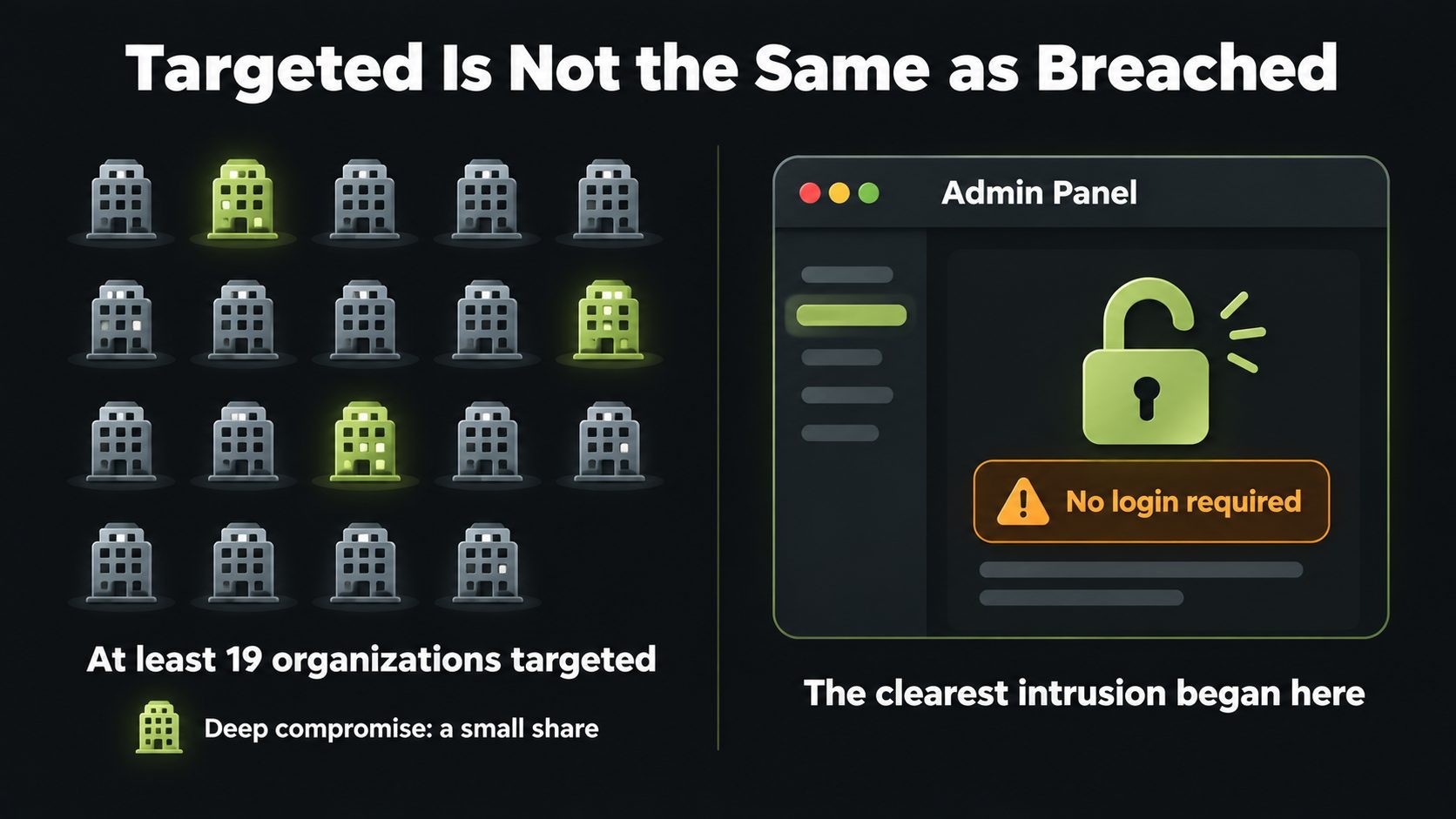
TrendAI identified at least 19 organizations that were targeted by the CyberStrikeAI campaign, including at least 16 in Japan. The operator also went after organizations in Taiwan and Hong Kong. These numbers are a minimum, because researchers could only count the targets they could clearly identify.
The victims were not giant corporations. Most targets were legacy web systems at smaller businesses and local public-sector organizations, and the targeting was opportunistic across many industries. In other words, the platform went wherever it found an easy way in.
It is important to be precise here. Being targeted is not the same as being breached. TrendAI found deep compromise in only a small share of the targets, with one company showing the clearest full intrusion chain.
That intrusion is the most useful lesson in the whole report. It did not start with a clever new exploit. It started at an unauthenticated, publicly accessible admin interface on an old web system. One forgotten admin page, open to anyone on the internet, was all the AI agents needed.
Not Just CyberStrikeAI: The Other AI-Driven Attacks on Japan
CyberStrikeAI was the most automated case in TrendAI's report, but it was not alone. The other two campaigns show the full range of how attackers are using AI today.
Campaign 2: A human operator with an AI assistant
In the second case, a human was clearly in charge, using a large language model to speed up planning and build tools. One of the operator's side goals was unusual: targeting AI workflow platforms and inference services to get large amounts of AI computing power cheaply. The operator broke into a geographic information system (GIS) server that still used default credentials, and took cadastral and commercial records, Windows credentials and email data. The activity ran for 24 days across August and September 2026.
Campaign 3: An experienced operator, with AI in a supporting role
In the third case, AI only helped write the operator's tools and scripts. This operator targeted edge devices from Cisco, Citrix, F5 and Yamaha, along with exposed VPN devices and Oracle WebLogic servers, in at least six campaigns between January and October 2026. Access came through published vulnerabilities, management functions or credentials found in configuration files.
The ARTEX connection
TrendAI's report is titled "Not Only ARTEX" for a reason. ARTEX is a separate, Chinese-developed AI penetration testing tool. In October 2026, GMO Cybersecurity by Ierae linked it to attacks on about 20 Japanese companies, run from six servers. CrowdStrike had earlier tied ARTEX to attacks on banks in South Korea. ARTEX and CyberStrikeAI are different tools, but together they show that AI-driven attacks on Japan are a pattern, not a one-off.
What AI Changed, and What It Did Not
It is easy to read about 44 AI agents and assume attackers now have superpowers. The reality is more useful, and more reassuring.
What AI changed:
- Scale. One operator could attack many organizations in parallel.
- Speed. Work that took a team weeks happened in days.
- Repeatability. Every target went through the same polished workflow and got its own report.
Microsoft's 2026 Digital Defense Report adds a worrying data point. It says AI has cut the median time from vulnerability discovery to weaponization to well under 24 hours. Patch windows are shrinking fast.
What AI did not change: the weaknesses. Every campaign in TrendAI's report relied on the same old entry points: exposed admin interfaces, default or weak credentials, unpatched edge devices and legacy web systems. As the researchers put it, the work still consists of "looking for unlocked doors". AI just checks far more doors, far faster.
The same pattern shows up in other recent attacks. The AuthMask vulnerability in Microsoft Authenticator let attackers skip passwords by stealing tokens, through a trust check that should have been stricter.
Myth vs reality
| Myth | Reality |
|---|---|
| AI attack tools invent new exploits on demand | In these campaigns, no new vulnerabilities were reported |
| Only big companies get hit | Most targets were smaller businesses and local public-sector bodies |
| You need advanced AI defenses to stop them | Basic controls would have closed the doors these attacks used |
What CyberStrikeAI Means for Your Business
If your business is in the United States, it is tempting to file this under "a problem in Japan". That would be a mistake.
CyberStrikeAI is free and open source, so anyone anywhere can use it. The FortiGate campaign that used it hit more than 55 countries. Location is not protection.
Small and mid-sized businesses are the natural target. They often run older websites, forget about admin pages and test sites, and rely on small IT teams or a single outside contractor. AI makes it cheap to attack thousands of these small targets at once, so the old idea that "we are too small to be worth hacking" no longer holds.
Stolen and exposed credentials are a recurring theme, too. The UpdraftCentral backdoor attack on WordPress sites this month relied on stolen remote management keys, not broken code. If you are not sure what your business exposes online, professional website and IT security services can help you find out before an attacker does.
How to Protect Your Business From AI-Automated Attacks
The good news is that you do not need AI to fight AI here. These attacks used basic, known weaknesses, so basic, well-applied controls stop them.
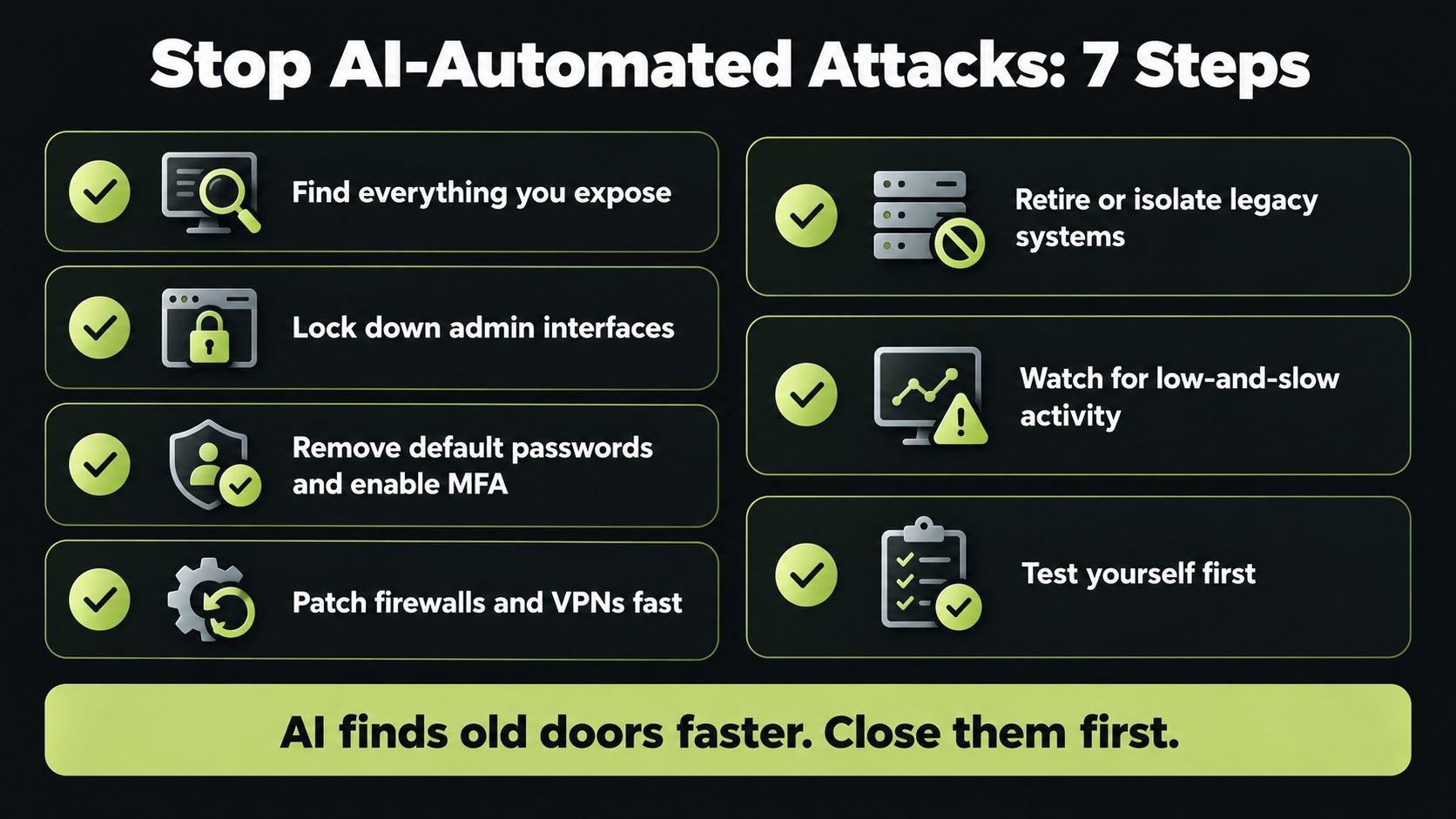
1. Find everything you expose
Make a list of everything your business has on the internet: websites, admin panels, VPNs, firewalls, remote desktop tools, and old test or staging sites. You cannot protect what you do not know exists. A technical website audit is a good starting point for finding forgotten pages and subdomains.
2. Lock down admin interfaces
Never leave admin pages or firewall management interfaces open to the whole internet, and never without a login. Put them behind a VPN or restrict them to known IP addresses. This single step would have blocked the clearest intrusion in the CyberStrikeAI campaign.
3. Remove default and weak credentials
Change every default password on devices and software, use unique passwords, and turn on multi-factor authentication (MFA) for every remote access point, including VPNs and admin accounts.
4. Patch edge devices fast
Firewalls, VPNs and remote access tools are the front door, so update them first. With AI shrinking the time from disclosure to attack to under a day, consider a web application firewall (WAF) or virtual patching to protect systems while you wait for a fix.
5. Retire or isolate legacy systems
Old web apps and outdated CMS installs are the easiest way in. If you cannot remove them, isolate them from the rest of your network. If a business-critical system is too old to secure, it may be time to rebuild legacy web systems securely.
6. Watch for low-and-slow activity
CyberStrikeAI throttled its traffic so each victim saw only small signals. Review logs over days and weeks, and across systems, rather than only alerting on big spikes.
7. Test yourself first
Run your own authorized vulnerability scans and penetration tests on a regular schedule. The same kind of automation attackers use can work for you, as long as you find the unlocked doors before an AI agent does.
If your team writes code, the developers' own machines are part of that attack surface too. Our developer laptop security guide shows how to lock them down.
This alert is part of our website security for small business guide, which puts every 2026 incident into a layer-by-layer plan you can follow.
Not sure if this affects you? I've recovered 50+ attacked websites. Request a security review.
Frequently Asked Questions
Conclusion
CyberStrikeAI proves that AI agents can now run an entire cyberattack, from the first scan to the stolen data to the final report, with very little human effort. That is a real shift in scale and speed.
But the defense is not exotic. Close exposed admin pages, remove default passwords, patch your edge devices and retire legacy systems. Do those well, and an army of 44 AI agents finds nothing to open.
For more practical breakdowns like this one, read more cybersecurity guides on the blog. And if you want to know what your business looks like to an attacker, book a security review.
Get new posts by email
New guides and alerts, sent when they are published. No spam. Unsubscribe anytime.



Comments (0)